Reduced Graphene Oxide (rGO)
Overview
Reduced graphene oxide (rGO) is produced by the chemical or thermal reduction of graphene oxide. This material is highly valued in industrial applications for its ability to combine the high surface area and mechanical strength of graphene with enhanced solution processability.
Production Technique
The production of reduced graphene oxide (rGO) relies on the reduction of graphene oxide to graphene using chemical, thermal, or microwave methods. To eliminate functional groups, oxygen-containing species are either removed, or the resulting regions are rearranged to restore a long-range conjugated structure.
The synthesis of reduced graphene oxide is based on the removal of functional groups (-OH, -COOH) from graphene oxide. For the graphene oxide reduction detailed on our website, a chemical method is employed. Upon request, rGO can also be synthesized using thermal or microwave methods.
Reduced graphene oxide can be supplied in powder form with batch capacities ranging from 1 to 10 grams.
Pricing
| Quantity | Price (EUR, Tax not included.) |
|---|---|
| 1 g | 460 € |
| 2 g | 740 € |
| 5 g | 1,480 € |
| 10 g | 2,370 € |
Characterization data for the produced rGO, including detailed interpretation of the results, is available with additional charges.
For up to date prices, request a quote.
Characterization
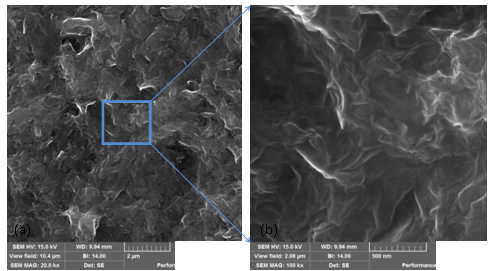
SEM Analysis
The scanning electron microscopy (SEM) image displays reduced graphene oxide (rGO) synthesized via chemical reduction. At high magnification, the characteristic morphology of rGO is clearly visible, exhibiting a cloud-like structure composed of wrinkled sheets.
XRD Analysis
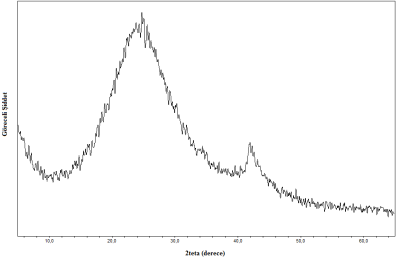
The X-ray diffraction (XRD) pattern of the chemically reduced graphene oxide (rGO) reveals a basal hexagonal peak corresponding to the (0001) plane. Rietveld analysis of this plane indicates an average crystallite size—representing the layer thickness—of 1.2 nm, which corresponds to approximately 3–4 basal layers. The main diffraction peak at 26° appears broadened, characteristic of the nanocrystalline nature of the material. Furthermore, a low-intensity asymmetrical peak at 42° corresponds to the (111) plane, reflecting the complex stacking orientation between the graphene sheets.
FTIR Analysis
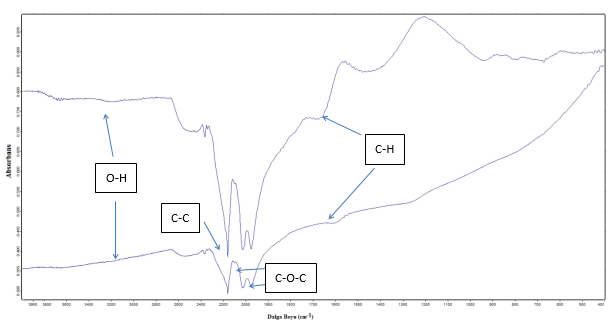
The Fourier Transform Infrared (FTIR) spectroscopy analysis illustrates the reduction of graphene oxide (GO) using both chemical (top) and microwave (bottom) methods. The spectra reveal a substantial elimination of OH groups, which previously corresponded to interlayer water molecules in the GO precursor. This confirms a successful reduction, transforming the material into few-layer or monolayer graphene. Furthermore, the characteristic 'fingerprint' region—featuring C-C skeletal vibrations, asymmetric and symmetric C-O-C stretching, and low-intensity asymmetric C-H bands—was clearly identified, establishing the integrity of the primary carbon framework.